


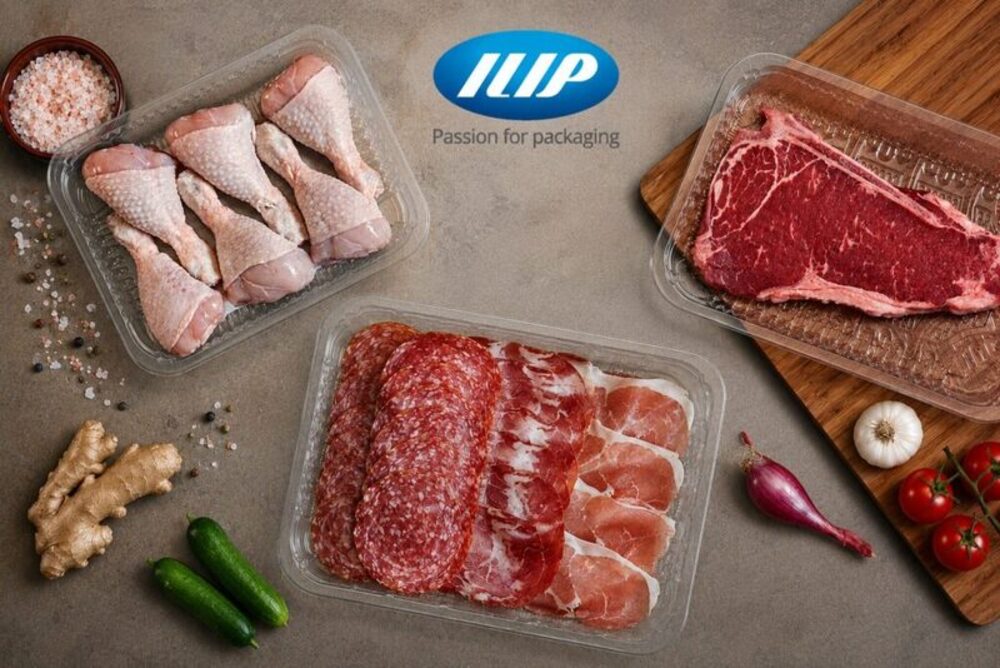
Ilip, a specialist in sustainable food packaging and part of the Ilpa Group, has unveiled significant additions to its fresh food packaging portfolio.
Ahead of Cibus Tec 2026, the company is presenting new tray designs, alternative sustainable materials, and proprietary mechanical exudate management solutions. Together, these developments are intended to improve production efficiency while supporting stronger environmental performance across the food and beverage industry.
The latest portfolio updates centre on three principal product families: HeatSealingMaster, StretchMaster, and SliceMaster. Each range reflects Ilip’s focus on eco-design, combining lower resource consumption and greater use of recycled materials with the functional standards required by modern food manufacturing trends and food processing technology.
Improved exudate control
One of the most important developments is the new Macrocell bottom, now available in MT230 and MT250 formats for the HeatSealingMaster range. Designed for applications that require greater fluid capacity, Macrocell extends the capabilities of Ilip’s established Microcell solution.
Both technologies incorporate mechanical absorption into the tray base. The integrated structure captures and holds exudates from meat, fish, and poultry inside the tray, removing the requirement for separate absorbent pads. This approach simplifies packaging operations and supports more efficient material recovery at the end of the product’s life.
Updates to the core product ranges
HeatSealingMaster is developed for modified-atmosphere packaging (MAP) and standard fresh food sealing applications. The range includes Evo, made from monomaterial PET; Duo, manufactured with PET/PE; and Bio, produced from EN 13432-certified compostable bioplastic. New M230 8-Hamburger and 1/2 Gastro formats expand the range’s suitability for meat, prepared foods, and fresh produce.
StretchMaster is intended for automated packaging equipment that uses stretch film or flow-pack systems. The portfolio now includes a 195 × 144 mm format and is available in monomaterial PET with a high recycled content or in compostable bioplastic. The Evo version can additionally be specified with a Microcell bottom.
SliceMaster completes the offering with specialist heat-sealable trays based on an m R-PET/EVOH/PE barrier structure. These trays are designed specifically for MAP applications involving cold cuts, sliced meat, and cheese.
Combining environmental progress and packaging performance
”In food packaging, sustainability cannot be separated from performance,” notes Giovanni Donini, business manager foodservice packaging & fresh food packaging at Ilip. “Reducing a tray’s weight or increasing its recycled material content only makes sense if the product continues to deliver the required levels of safety, preservation, and reliability on packaging lines. That is why we work to optimise materials and structures, with the aim of using resources more efficiently without compromising packaging functionality.”
This approach is supported by the Ilpa Group’s vertically integrated T2T R-PET, or tray-to-tray, circular system. Its closed-loop recycling model uses secondary raw materials from conventional bottles as well as post-consumer food trays and punnets. Ilip’s R-PET packaging currently contains an average of around 80% recycled material, helping close the materials loop while maintaining rigorous food-contact safety and traceability requirements.
The development also reflects wider food and drink sustainability priorities, as well as evolving food and drink regulations governing recycled content, product safety, and packaging recovery. By integrating material efficiency into its product design, Ilip is responding to food and drink consumer trends and the growing demand for responsible food and drink packaging.
Visitors can examine the expanded portfolio at Cibus Tec 2026, running from October 27 to 30 at Fiere di Parma in Hall 2, Stand E020. The showcase will provide an opportunity for industry professionals to assess how the latest solutions support food and drink industry innovation, alongside changing food distribution trends, food and drink marketing priorities, and broader food and beverage industry trends.