


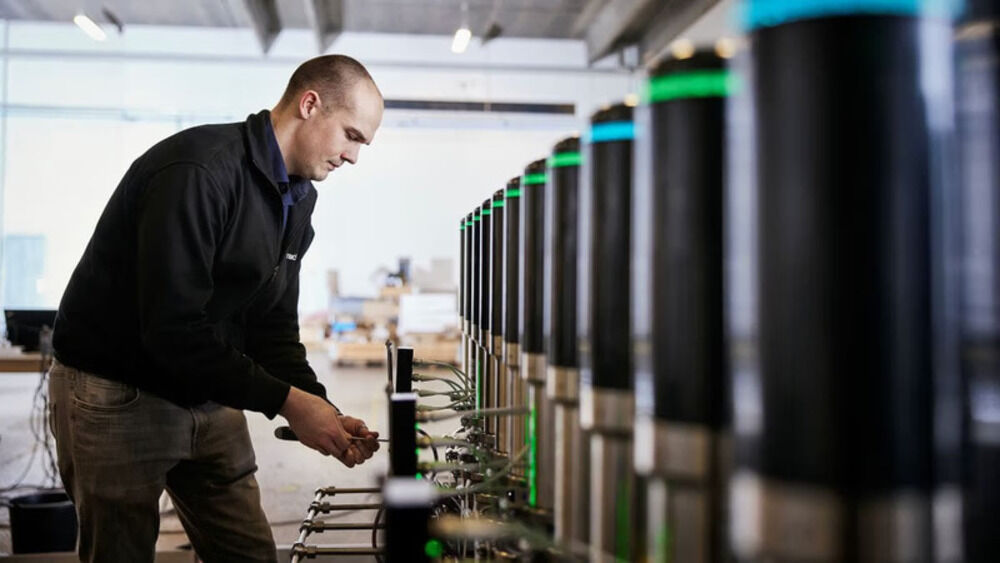
GEA has added its water-hydraulic Hydract actuation system to the modular Varivent valve range, giving breweries and beverage producers a practical route to lower capital investment and day-to-day operating costs.
The technology replaces traditional compressed-air actuators with a highly accurate, water-hydraulic alternative. Integrated with inline blending, the solution can reduce both capital expenditure (CAPEX) and operating expenditure (OPEX), while supporting wider food manufacturing trends focused on efficiency, flexibility, and resource conservation.
Economic and cost benefits
Lower tank investment: In a greenfield brewery project, accurate inline blending can reduce the number of bright beer tanks (BBTs) required from 26 to 14, delivering a potential tank CAPEX saving of up to 46%.
Improved equipment utilisation: Average tank utilisation can rise from 54% to 90%. As a result, producers can increase output without immediately investing in facility extensions or additional tank capacity.
Significantly lower actuation energy consumption: Hydract eliminates the need for energy-intensive compressed-air generation. Instead, its closed-loop hydraulic circuit uses treated water or a water-glycol solution, reducing electricity costs associated with valve actuation by more than 95%. This approach aligns with food and drink sustainability objectives and the wider adoption of efficient food processing technology.
Reduced inventory and working capital requirements: Late-stage product differentiation enables breweries to blend streams continuously close to the filling line, rather than producing and storing several finished variants weeks ahead of demand. Tank-to-bottle lead times can therefore fall from weeks to hours, releasing working capital and reducing the need for buffer stock. These capabilities also respond to evolving food distribution trends and food and drink consumer trends, including demand for greater variety and faster product availability.
Lower cleaning and operating expenditure: Fewer tank configurations and less finished-product storage can reduce clean-in-place (CIP) requirements, chemical consumption, water use, and product waste. The result is a more efficient operation that supports current food and drink sustainability priorities.
Designed for targeted upgrades
Producers can install Hydract on existing Varivent valve matrices and operate the system alongside legacy pneumatic valves. This retrofit option allows manufacturers to prioritise process stages with the strongest return on investment, without undertaking a complete plant modernisation. Such flexibility is particularly valuable as food and beverage industry trends continue to favour phased investment and adaptable production infrastructure.
Proven performance in commercial production
Commercial operation at Carlsberg’s brewery in Fredericia, Denmark, confirmed that important parameters—including Brix, alcohol concentration, and CO₂—remain consistent despite substantial changes in throughput.
“Precise valve control gives us significantly more room for maneuver in process design,” noted Bastian Tolle, head of business development & digitalisation at GEA’s Valves & Pumps unit. “Product variants can be created later, existing tanks are better utilised, and new plants can be planned with less buffer and tank capacity. For breweries with growing product portfolios, this represents a very concrete economic lever.”
Anders Kokholm, head of brewing and quality management at Carlsberg Supply Company Denmark, added: “With Hydract valves, we can precisely control the process even when the valve is closed. This gives us the opportunity to manufacture product variants shortly before bottling, maintaining lower inventories, increasing efficiency in the filling plant, producing on-demand just-in-time, and reducing product losses.”
GEA is introducing Hydract actuation for key Varivent configurations, including single-seat Type N, changeover Type W, and double-seat Types R and D valves. Additional models will follow. The system will be demonstrated at BrauBeviale 2026 in Nuremberg, Germany, in Hall 9, Stand 362.
By combining precise valve control with flexible inline blending, the solution reflects broader food and drink industry innovation across production, food and drink packaging, food and drink marketing, and the changing demands of food and drink regulations.