


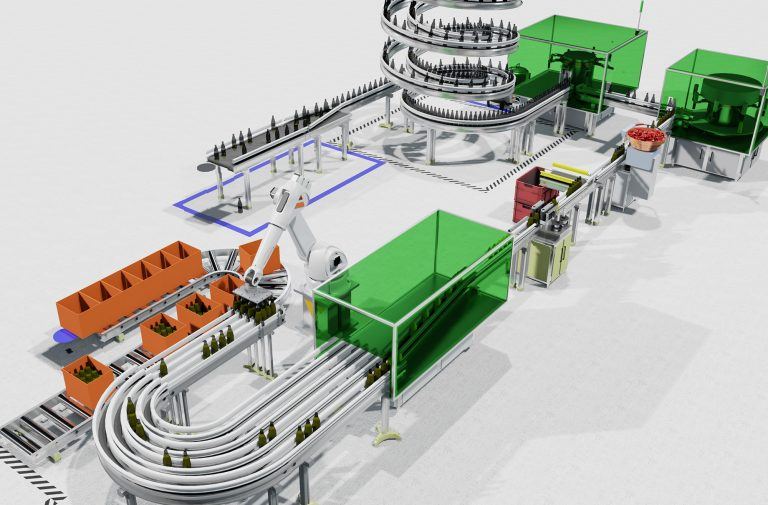
Visual Components, a specialist in 3D manufacturing simulation and robot offline programming, has introduced FactoryLens, a new viewport integrated into its simulation platform.
Built with NVIDIA Omniverse libraries, the technology represents the latest development in Visual Components’ ongoing collaboration with NVIDIA.
FactoryLens enables manufacturers to transfer existing simulation layouts into a more immersive digital-twin environment without leaving the software they already use. The viewport delivers real-time rendering for production facilities, warehouse operations and manufacturing workflows, including applications in the food and beverage sector.
Visual Components’ 3D simulation software helps manufacturers design, assess and optimise factory layouts before construction begins. FactoryLens builds on these established capabilities by adding a more realistic digital-twin experience within the familiar platform.
Visual Components chief technical officer and co-founder Mika Anttila said: “We believe the future of manufacturing is built on connected digital twins, not isolated applications.
“FactoryLens is our first step in bringing NVIDIA Omniverse libraries into Visual Components, so manufacturers can see how their factories will really look and behave before they build them, while keeping the productivity and ease of use our customers already know.”
Users can create factory and warehouse simulations from a catalogue of more than 4,000 components. The library includes robots, machinery, conveyors, autonomous mobile robots, forklifts and other equipment used across production, intralogistics and material handling operations.
FactoryLens enhances these simulated environments with a photorealistic visual layer driven by NVIDIA RTX, while NVIDIA PhysX continues to provide the realistic physics required beneath the surface.
Visual Components business development director Mustafa Kamal said: “Integrating NVIDIA technologies into Visual Components brings increased physical accuracy and fidelity to simulated worlds, and is a natural fit for the rise of physical AI and the value simulation brings to that domain.
“Combining NVIDIA’s open libraries and frameworks with the fast, easy-to-use simulation products of Visual Components opens the door for everyone to build realistic digital twins.”