


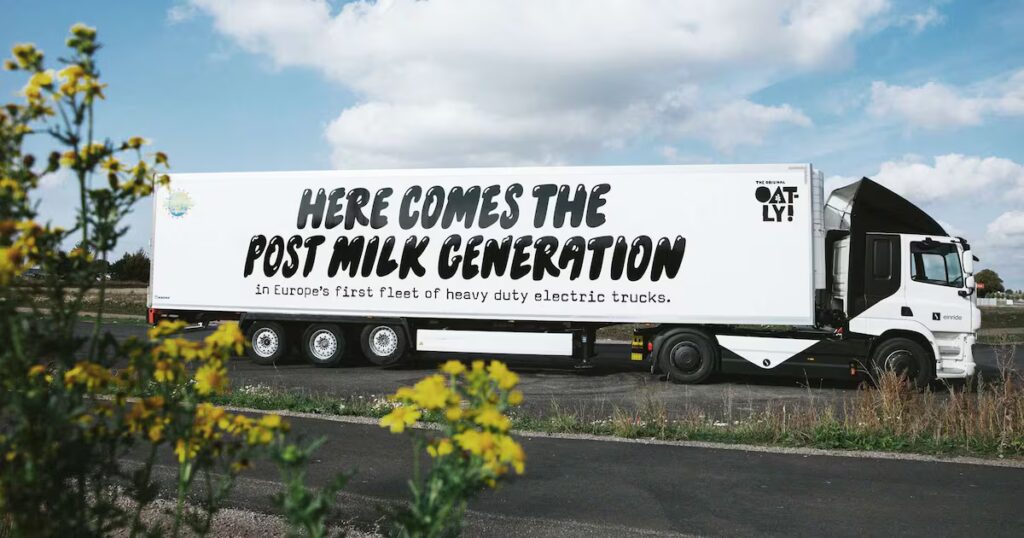
The Supreme Court has ruled against Oatly, prohibiting the use of the phrase ‘Post Milk Generation’ in its branding and marketing efforts, citing a violation of regulation 1308/2013.
This regulation protects dairy terms—including milk, cheese, and yogurt—restricting plant-based alternatives from using such terms in their descriptions. Therefore, designations like ‘plant-based milk’ are not permitted.
Oatly has vigorously defended its use of ‘Post Milk Generation’ since 2021, following Dairy UK’s initiative to ban it.
Initially, Dairy UK’s application was upheld by the Intellectual Property Office. However, Oatly’s appeal was successful in the High Court, where Judge Richard Smith upheld the trademark. This decision was later overturned by the Court of Appeal, prompting Oatly to escalate the matter to the Supreme Court.
Oatly maintained that ‘Post Milk Generation’ should not be banned, arguing that it does not function as a product designation and is instead a reference to a consumer demographic.
Nonetheless, the Supreme Court sided with Dairy UK, concluding that any trademark containing a protected term—regardless of its use in a slogan—constitutes a breach of the existing regulation.
Thus, the UK Intellectual Property Office (UKIPO)’s original ruling is reinstated, enforcing the cancellation of Oatly’s trademark for ‘Post Milk Generation.’ Consequently, Oatly is barred from using this phrase in marketing dairy-free alternatives.
“It has taken the highest court in the land to decide once and for all whether a plant-based milk alternative can be branded as ‘milk’ and marketed as such. And the outcome is not what Oatly was hoping for,” stated Laurie Bray, senior associate and trademark attorney at Withers & Rogers.
“EU regulation is clear that certain terms can only be applied to the actual products that they describe—for instance, milk, wine, and olive oil. Milk is defined as ‘the normal mammary secretion’ from milking, ‘without any addition or extraction.’ This EU regulation continues to hold in the UK as ‘assimilated law.'”
“Oatly argued that the trademark’s use of the term milk does not breach this regulation if it is not employed descriptively.”
Bryan Carroll, general manager for Oatly UK & Ireland, expressed the company’s “deep disappointment” in the ruling.
He added: “At Oatly, we will always advocate for what is right. Prohibiting the trademarking of ‘Post Milk Generation’ stifles competition and is not in the interests of the British public. This ruling causes unnecessary confusion and uneven competition, primarily benefiting Big Dairy.”
“Despite today’s ruling, we remain committed to promoting positive change and advocating for a sustainable food system that does not recklessly tax the planet’s resources. We will continue working to distribute our ‘Post Milk Generation’ merchandise to our community.”
Dr. Judith Bryans, CEO of Dairy UK, expressed that the organization is “delighted.”
“This ruling is significant for the sector as it clarifies how dairy terms can and cannot be utilized in branding and marketing,” she remarked.
“It ensures greater certainty for businesses and allows established dairy terms to deliver clear meaning to consumers while facilitating the use of proper descriptors where legally permissible.”
Moreover, this legal battle may not conclude here, as Bray noted that Dairy UK is likely to pursue Oatly’s other trademark registrations.
“Oatly holds multiple UK trademark registrations for ‘POST MILK GENERATION,’ and based on this verdict, Dairy UK may aim to cancel these other registrations, particularly those tied to milk alternatives. It remains uncertain whether Oatly’s EU registrations will also face similar scrutiny from Dairy UK’s European counterparts,” she elaborated.
Bray further advised: “The key message for brand owners developing new plant-based products is to recognize that plant-based milk alternatives do not equate to milk, and should not be branded as such. The same applies to terms that denote milk-based products like cream, butter, cheese, and yogurt, all protected under the EU regulation. Alternative descriptions such as ‘oat drinks’ are acceptable.”
“Applying for trademark protection for key names and slogans remains a wise strategy for innovative food and drink businesses aiming to fortify their position in a rapidly evolving market. Employing specialist certification marks for plant-based or vegan products, such as the Vegan Society’s Sunflower, may also enhance their visibility on shelves.”