


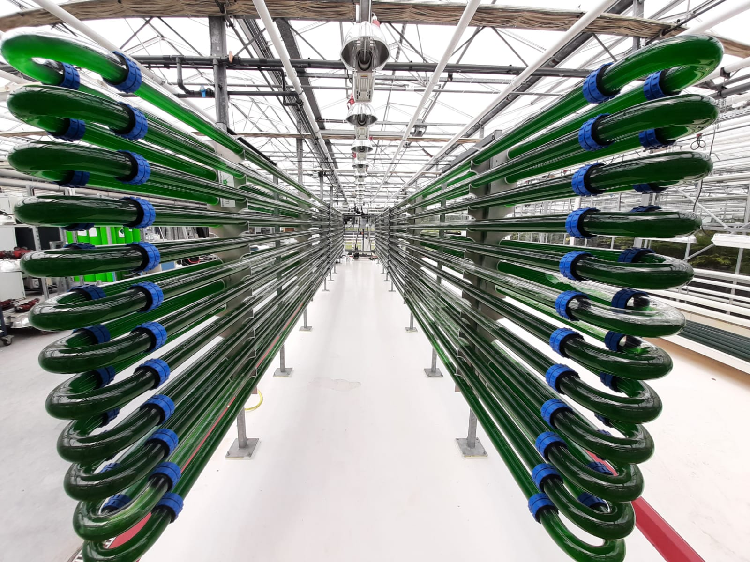
In the fourth year of European-funded Horizon 2020 research project ProFuture, researchers at Wageningen University have developed a way of producing a microalga species for alternative protein. The project, instigated in 2019 and running for four years, aims to scale up microalgae production and prepare the market for uptake of microalgae proteins for both food and feed. This initiative looks to be promising, because microalgae is considered one of the most hopeful future prospects for sustainable, nutritious protein for a growing population. The project group is coordinated by the Institute of Agrifood Research and Technology (IRTA) in Spain, and consists of representatives from Wageningen University & Research, Ghent University, Coop Group, AlgoSource, and EUFIC.
For the mission of the ProFuture project to become more sustainable and competitive, innovative technology and cost-effective production processes must be put in place. The ProFuture researchers found the Galdieria sulphuraria strain growing in hot springs near Naples, Italy. The extremophile microalga has a blue pigment and is thought to be a resilient source of protein for the future. The researchers claim that this is the first time the strain is being examined as a potential food source, and it also marks the first time G. sulphuraria has been produced at scale.
The strain has a protein content of 62-65%, which is relatively high compared to other algal and fungal microorganisms with protein contents ranging from 30-70%. G. sulphuraria proteins have a good amino acid profile, including all essential amino acids. The proteins are especially rich in cystine and methionine, two amino acids rarely found in such high levels in non-animal-based proteins. In addition, the researchers also see potential in the microalga strain’s pigment. G. sulphuraria is amongst the few natural sources of blue pigments. The strain contains a high concentration of a natural blue pigment commonly used by the food industry, as well as cosmetics.
The researchers developed a process using mixotrophy to produce the microalga strain on a large scale. The technique combines both photosynthesis and sugar-based feedstock to stimulate the growth of microalgae. They demonstrated pilot production in a 13,000L (1.5 cubic metre) bioreactor at Wageningen University. To effectively exploit the ‘promising’ results, the researchers will have to assess its digestibility and identify additional processing methods required for commercial applications.
According to the research team, “The European Food Safety Authority (EFSA) is currently assessing the safety of Galdieria sulphuraria as a novel food for the general population and as a food supplement for adults. In addition, Blue Galdieria extract is [being] assessed as a food additive.”