


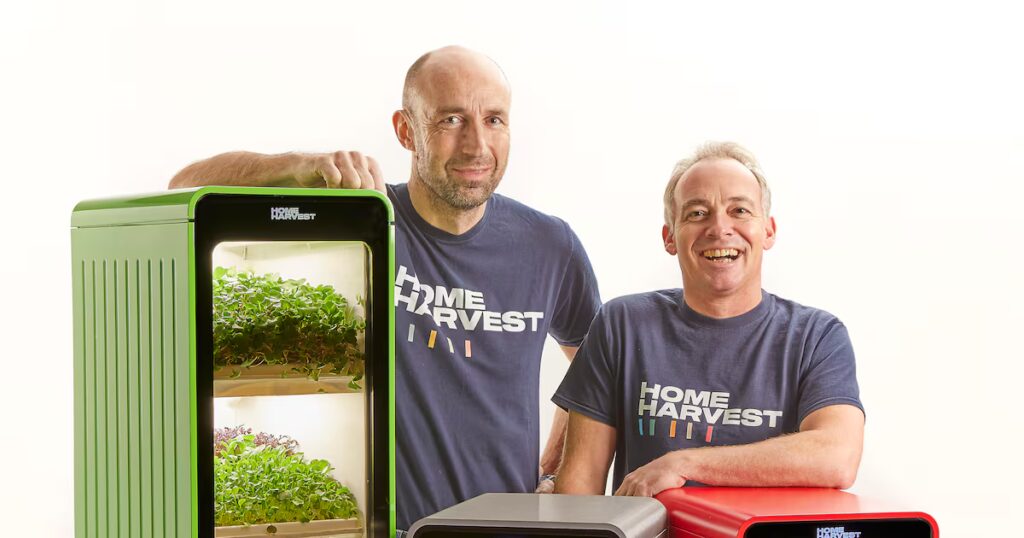
The recent innovation follows the rise of vertical farming that captured media attention years ago, highlighting its potential in cultivating crops within controlled and sustainable settings.
Although smaller-scale solutions for indoor gardening are already available, Home Harvest distinguishes itself by offering a fully connected system where the agricultural processes are completely automated.
These compact at-home vertical farms operate on low voltage, costing approximately £2 per month in electricity. They come in two configurations: one features three trays for growing crops, while the other has a single tray. The larger unit resembles a slim mini fridge, and the smaller version is about the same size as a large microwave, both available in contemporary colors.
To get started, a unit priced around £339 must be purchased. Users can then order their ‘seed mats’—recyclable fabric embedded with seeds and fertilizer—place them in the trays, and fill the water tank. The subscription-based seed mats cost between £10 and £15 monthly and are tailored with specific recipes focused on various themes, including Italian herbs, prenatal nutrition, gut health, and vitamin enrichment.
Each seed mat comes with a QR code, which enables users to utilize the Home Harvest app. This allows them to log their crops, with the app automatically adjusting the lighting, temperature, and humidity as needed.
The larger models facilitate simultaneous growth of three different crop varieties, with the app optimizing conditions for each section. Cameras inside the farms enable users to capture images and create time-lapse videos of their plants’ development. Additionally, the app provides essential details regarding harvesting times and offers recipe ideas based on the crops being grown.
“In the future, we plan to utilize AI to monitor crop size, assess plant health, gauge growth rate, and suggest optimal harvesting times,” co-founder Hedley Aylott stated. He explained, “By carefully tracking what each user grows, the timing of their harvests, and their biometrics, Home Harvest aims to develop the world’s most detailed database on ‘Live-Nutrition’ efficacy.”
The primary objective of this innovation is to enhance access to fresh and varied produce—ranging from microgreen radishes to chervil and fenugreek—while presenting a sustainable option that minimizes waste, transportation distances, and chemical usage.
However, the implications for manufacturers within this category are complex. Aylott pointed out that Home Harvest is not intended to take over the market for pre-packaged salads. Yet, it does provide opportunities for consumers to replace portions of their grocery shopping with cheaper, fresher, and more eco-friendly alternatives.
He articulated the efficiency of their product by explaining, “In this mat is 2kg of lettuce seed – that is equivalent to 50 trucks worth of lettuce.”
The commitment to reducing waste has been a significant motivator for Aylott and his business partner Andrew Johnson, the creator of the Living Salad concept, which debuted in retail in 2005, allowing customers to purchase potted salad plants.
“I have experience in the salad industry and am aware of the considerable waste generated by this sector and its environmental repercussions,” Johnson explained. “Around 30% of planted leafy salad crops are consumed, with the remainder discarded.” He noted, “The UK imports about 1,000 trucks of leafy salads each week from Southern Europe and Africa, discarding approximately 400 trucks-worth.”
The Home Harvest units have taken four years to develop and are scheduled to launch this summer in both the UK and the US. While Aylott acknowledges that these units may not fully replace herbs and bagged greens yet, he remains optimistic about their potential to disrupt the market.
“Currently, no one is searching for this product because they are unaware it’s feasible,” he remarked. “But I believe there will come a time when Home Harvest achieves a tipping point, and people will realize the possibilities. If it’s that straightforward and cost-saving, why wouldn’t you choose it?”
Referring to the intense flavors of the crops that Food Manufacture had the opportunity to sample, he added, “It will prompt consumers to rethink their food sources, their health benefits, and the nutritional value of what they consume.”
Aylott envisions a future where these units are as common as kettles, potentially integrated into kitchen cabinetry like ovens. “Everyone will grow their own – why wouldn’t they? It’s beneficial for the planet, your health, your family, and your finances,” he expressed regarding future prospects.
This innovation indeed has the potential to transform the fresh greens market, but its success will depend on effective marketing strategies, the user-friendliness of the technology, and consumers’ perceptions of its convenience.
To date, Home Harvest has raised £1.2 million in funding and continues to seek additional financial support.