


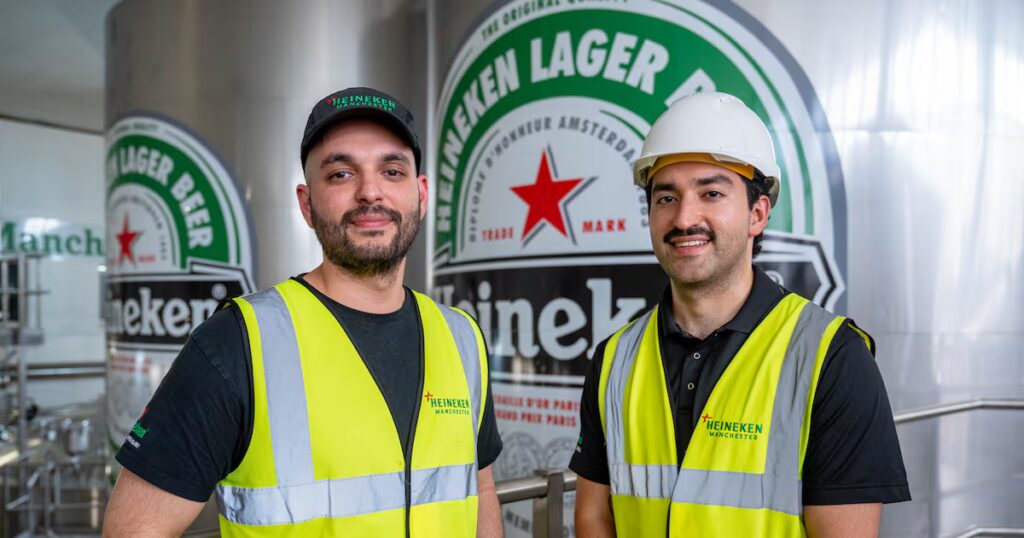
Heineken UK has cut natural gas consumption at its Manchester brewery by 33% after investing £28.2 million in large-scale industrial heat pump technology.
The Dutch brewing group committed the funding in 2023, with installation work beginning soon afterwards. The system was commissioned last year, and the latest performance data shows that it has reduced the site’s carbon dioxide emissions by 42%.
Heineken said the project represents an important milestone in its “sustainability journey” and supports the wider decarbonisation of its beer manufacturing operations. The heat pump network is now fully integrated across the brewery, reducing the site’s dependence on natural gas for heating and changing the way the facility generates and uses energy.
By lowering gas consumption, the project also limits the brewery’s exposure to fossil fuel costs and energy market volatility. It demonstrates how food manufacturing trends are increasingly shaped by investment in energy efficiency, industrial decarbonisation and long-term operational resilience.
Chris Kerr, supply chain director at Heineken UK, said: “Decarbonising a brewery requires a combination of technology and skill, and is a complex challenge facing our industry. This project marks a step change in how energy can be generated and used in our Manchester Brewery and has impacted every part of our operations from inception to launch. It has been transformational for one of the largest breweries in the UK.
“Our team at Manchester are truly at the heart of this project and they have worked tirelessly behind the scenes to make this possible, adapting day to day while continuing to brew brilliant beer. Their support, drive and ability to continuously optimise the system to our specific requirements is what’s helping us decarbonise brewing while continuing to innovate at our historic brewery.”
He continued: “We’re confident in the heat pumps’ continued positive performance, with the installation already achieving on average 80% of the estimated on-site gas reduction. This is a blueprint not just for us at Heineken UK, but for the wider brewing and manufacturing sectors, demonstrating how investment in low-carbon technology can deliver both environmental benefits and long-term operational resilience.”
The Manchester site is Heineken UK’s largest brewery. It produces around 2.5 million pints each day, including Heineken, Cruzcampo, Foster’s, Moretti and Red Stripe. The facility employs more than 240 people.
The project received £3.7 million through the government’s Industrial Energy Transformation Fund. The support helped accelerate the adoption of technology designed to reduce emissions from industrial operations.
The investment reflects several major food and beverage industry trends, including the growing use of food processing technology to improve efficiency and the increasing focus on food and drink sustainability across production networks. It also aligns with wider food and drink industry innovation, as manufacturers seek practical ways to reduce energy use without compromising output.
Although the project centres on brewing, its implications extend across the sector. Similar investment decisions may influence food distribution trends, food and drink packaging, food and drink marketing and responses to evolving food and drink consumer trends. At the same time, manufacturers must continue to account for changing food and drink regulations as they pursue lower-carbon production and more resilient supply chains.