


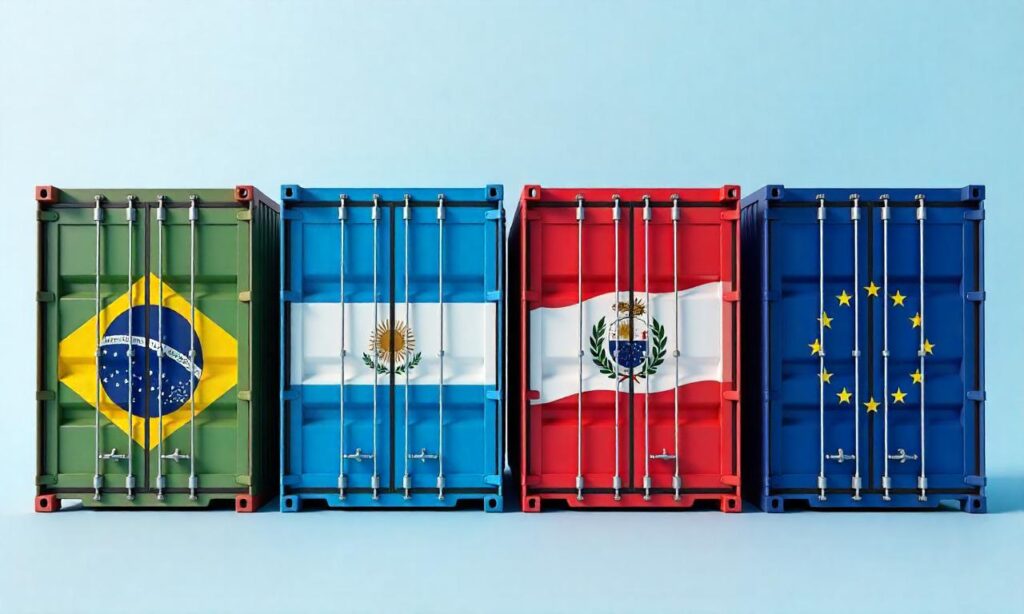
Farming groups across the European Union (EU) are voicing strong opposition to the proposed trade deal with South America’s Mercosur bloc. They argue that the agreement is “fundamentally unbalanced” and “flawed”, raising critical concerns over its implications for the agricultural sector.
This backlash followed a crucial vote on January 9, where a qualified majority of EU member states supported the trade accord with Brazil, Argentina, Paraguay, and Uruguay. The vote signifies a pivotal moment for EU-Latin America relations but has prompted significant dissent among agricultural representatives.
European Commission President Ursula von der Leyen expressed her optimism upon the signing of the trade agreement, stating, “We have delivered a substantive and mutually beneficial deal, which will increase prosperity and create incredible opportunities. This deal marks a new era of trade and cooperation with our Mercosur partners.” Her statement underscores the EU’s commitment to fostering strong economic ties with South American nations.
The European Council has also endorsed the deal, asserting that it offers significant tariff reductions and opens up access to new markets across various sectors. These include agriculture, automotive, pharmaceuticals, and chemicals, positioning the deal as beneficial for numerous industries.
However, Copa-Cogeca, representing EU farming organizations and agricultural cooperatives, expressed strong dissatisfaction with the deal. They stated that they are “united” in their opposition, despite recent adjustments to additional safeguard measures aimed at addressing their concerns.
Furthermore, the farming lobby warned that the agreement “erodes trust in European governance, democratic processes, and parliamentary scrutiny at a time when institutional credibility is already under strain.” This highlights a growing disconnect between trade negotiations and the agricultural community in the EU.
Copa-Cogeca further criticized the “last-minute decision” by the Council to withdraw a declaration that ensured no provisional implementation of the agreement would occur before the European Parliament’s review. They termed this development “extremely concerning” and vowed to mobilize farmers against the accord.
From the European Commission’s perspective, this trade agreement aims to create the “world’s biggest free trade zone,” which encompasses a consumer market exceeding 700 million people. Originally established in 2019, the deal has faced numerous delays due to opposition from various EU member states.
A “political agreement” was finally reached in December 2024, marking a critical step forward. EC President von der Leyen is set to travel to Paraguay for the formal signing of the agreement, which still requires ratification by the European Parliament.
The EU remains Mercosur’s second-largest trade partner, accounting for nearly 17% of the bloc’s total trade in 2024. In that year alone, the trade exchange in goods between the two regions reached an impressive €111 billion ($129.7 billion).
Central to the trade deal is a mutual reduction of import duties. The EU plans to gradually eliminate tariffs on 92% of Mercosur’s exports over a span of ten years. Conversely, Mercosur will phase out duties on 91% of EU exports over 15 years, signifying a bilateral commitment to enhancing trade relations.
President von der Leyen characterized the agreement as a “win-win solution,” adding, “We have heard the concerns of our farmers and our agricultural sector and we have acted on them. This agreement contains robust safeguards to protect their livelihoods.” Additionally, the EU intends to enhance its import control measures, emphasizing that compliance with regulations is imperative for all producers.
Moreover, the agreement offers opportunities for EU farmers, including the inclusion of 350 European geographical indications—an unprecedented feature in EU trade deals. This inclusion aims to elevate the status of European agricultural products on a global scale.
To alleviate concerns regarding competition from South American producers, the deal incorporates safeguard mechanisms and quotas for sensitive goods. Notably, a provisional understanding surrounding these measures was reached in December.
Both parties have agreed to stringent regulations that allow the EU to temporarily suspend tariff-free imports on “sensitive” goods—such as poultry, beef, sugar, eggs, and citrus—should rising import levels threaten European producers. Specifically, an investigation into potentially suspending preferential tariffs would be initiated if there is an increase in import volumes exceeding 8% or a price decline beyond 8% compared to the three-year average.
Furthermore, the Commission is authorized to monitor “non-sensitive products” at the request of domestic industries, ensuring ongoing vigilance regarding import impacts.
President von der Leyen noted that approximately 60,000 European companies currently export to Mercosur, with about half classified as small to medium-sized enterprises (SMEs). These firms stand to gain significantly from lower tariffs, which are projected to save around €4 billion annually in export duties, alongside more streamlined customs procedures and enhanced access to essential raw materials.
Looking ahead, the European Commission envisions that EU exports to Mercosur could surge by nearly €50 billion by 2040, while Mercosur exports to the EU may rise by as much as €9 billion, further solidifying the economic partnership between these regions.