


Over the past 12 months, sorting and weighing technology in food and beverage manufacturing has moved well beyond the idea of “standard automation”. What was once framed as Industry 4.0 is now evolving into a more advanced, resilient and human-centric approach aligned with Industry 5.0. The focus is no longer just speed and detection, but accuracy, sustainability, compliance and decision intelligence.
At the heart of this shift is a new generation of sensing and weighing technology. Traditional optical sorters relied primarily on colour and shape recognition through RGB cameras. Today, hyperspectral and near-infrared (NIR) imaging is becoming the benchmark. Using InGaAs sensors, these systems can analyse the chemical composition of food, identifying internal defects such as bruising, moisture variation or early spoilage that would previously have passed undetected. This level of insight is transforming quality control, particularly in fresh produce, proteins and ready-to-eat foods.
Weighing technology is undergoing a similar leap forward. In high-speed environments, electromagnetic force restoration (EMFR) checkweighing is increasingly replacing traditional strain gauge systems. EMFR offers milligram-level accuracy at speeds of 600 packs per minute and beyond, enabling manufacturers to tackle one of the most persistent cost drains in food production: giveaway. With inflation and ingredient volatility continuing to squeeze margins, reclaiming even fractions of a gram per pack can translate into six-figure annual savings.
Alongside accuracy, space and simplicity are driving equipment design. There is growing demand for integrated combination systems that bring checkweighing, metal detection and X-ray inspection into a single footprint. These compact solutions reduce floor space, streamline product flow and simplify training by using a unified human–machine interface. For facilities operating under tight space constraints or retrofitting older lines, this consolidation is becoming a decisive factor.


Reliability is also being redefined. Modern sorting and weighing machines increasingly incorporate AI-driven predictive maintenance, analysing vibration, load and performance trends to predict component wear before failure occurs. Rather than reacting to breakdowns, maintenance can be scheduled around production, supporting the industry’s push toward zero unplanned downtime.
Legislation is accelerating this transformation. For manufacturers exporting to the United States, FSMA 204 introduces strict traceability requirements, with the ability to provide the FDA with Key Data Elements within 24 hours becoming mandatory in the coming years. Sorting and weighing systems are now being positioned as critical data capture points, automatically linking weight, time, batch and location information to digital records.
In Europe and the UK, sustainability legislation is placing new demands on precision. The EU’s Packaging and Packaging Waste Regulation and the UK’s Extended Producer Responsibility framework mean that manufacturers must prove packaging minimisation and accurately calculate fees based on material weight and recyclability. Precision weighing is no longer just about product compliance; it directly affects environmental reporting and cost exposure through eco-modulation of fees. At the same time, upcoming updates to UK metrology regulations are pushing manufacturers away from manual records and toward fully digital, audit-ready data.
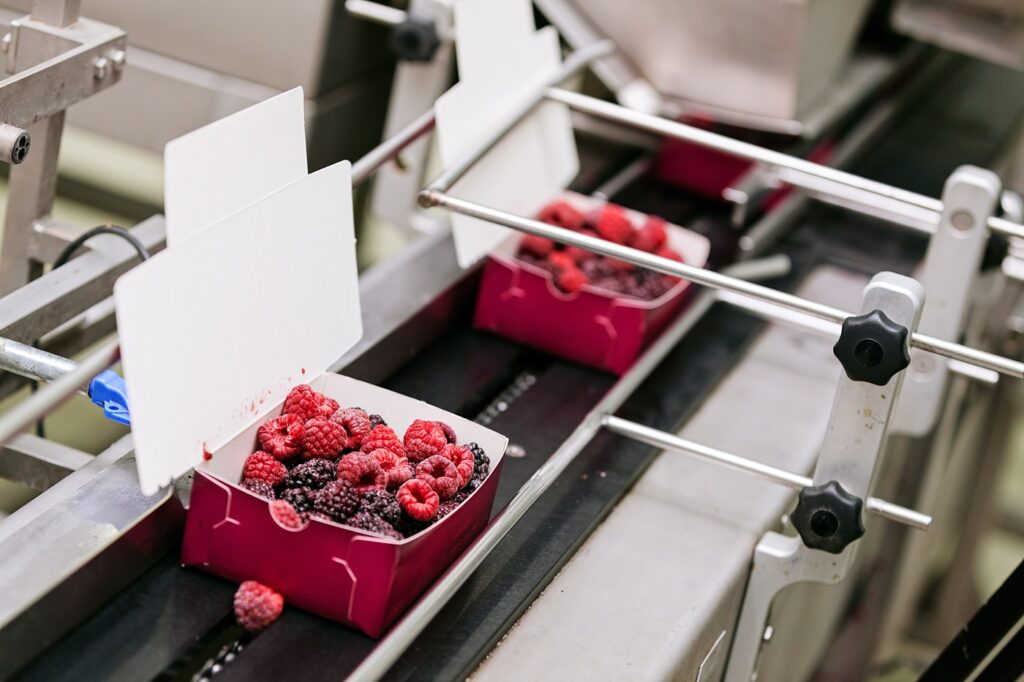
Crucially, this technological evolution is not about removing people from the process. Industry 5.0 places emphasis on human–machine collaboration. Collaborative robots are being paired with AI vision to handle delicate or irregular products that require judgement as well as speed, while engineers use weighing and sorting data to build digital twins of their lines. These virtual models allow changes to tolerances, speeds or inspection criteria to be tested safely before being applied on the factory floor.
Sorting and weighing are no longer isolated quality checks at the end of the line. They have become intelligent control points that protect margins, enable compliance, support sustainability goals and give engineers deeper insight into how their processes really perform. In today’s food and beverage landscape, precision is not just a technical advantage — it is a strategic one.