



Health, safety and hygiene have always been fundamental to food and drink manufacturing, but the way they are managed is changing. The traditional model of separate technical, production, engineering and safety functions is giving way to a more integrated approach, where people, products, equipment, buildings, packaging and data all form part of the same risk-control system.
Industry Insight: Health, safety and hygiene in food manufacturing is moving beyond basic compliance. The strongest manufacturers are now treating safety as a whole-site operating discipline, combining hygienic design, worker protection, allergen control, digital traceability, packaging assurance and food safety culture into one joined-up framework.
This matters because food factories are becoming more complex. Lines are faster, workforces are under pressure, ingredients move through longer supply chains and retailers expect stronger evidence of control. At the same time, regulatory expectations are becoming more dynamic, with closer attention on traceability, food contact materials, labelling integrity and the way large food businesses demonstrate compliance.
For manufacturers, the opportunity is clear. A safer factory is not only one that avoids accidents or contamination events. It is one that runs more consistently, protects staff, reduces downtime, strengthens audit readiness and gives customers confidence that risk is being controlled at every stage.
People, plant and product risk are converging
In the past, worker safety and food safety were often treated as separate disciplines. One sat with health and safety managers; the other with technical and quality teams. In practice, the two are closely linked.
Poor factory layout can increase contamination risk and create hazards for staff. Awkward access to equipment can make inspections harder and maintenance more dangerous. Congested walkways, poorly segregated zones, difficult manual handling tasks and badly designed production flows all increase the chance of human error.
This is why health, safety and hygiene must now be considered together at the design stage. Machinery guarding, safe access, floor condition, drainage, lighting, ventilation, pedestrian routes, vehicle movement and zoning all affect how safely and hygienically a site operates. A plant that is difficult to clean, inspect or maintain safely is a plant with higher operational risk.
For senior decision-makers, this means capital investment should not be judged only on throughput. Equipment and building upgrades should also be assessed on their contribution to safer access, reduced manual handling, better segregation, easier inspection and lower contamination risk.
Hygienic design without repeating the cleaning agenda
Hygienic design remains central, but it is broader than cleaning. It is about preventing risk from being designed into the factory in the first place.
Food-grade surfaces, cleanable welds, accessible components, sloped drainage, controlled air movement and separation between raw and ready-to-eat areas all support better hygiene outcomes. So do layouts that reduce unnecessary product movement, minimise staff crossover and make allergen segregation easier to manage.
The same principle applies to automation. Robotics, conveyors, vision systems and high-speed packaging lines can reduce handling and improve consistency, but only if they are specified for the environment. Equipment that is hard to inspect, traps product debris or creates inaccessible harbourage points can undermine safety even when it improves productivity.
The key message for manufacturers is that hygiene should be engineered into the process, not added afterwards through more procedures. Better design reduces dependency on human intervention and makes safe behaviour easier to sustain.
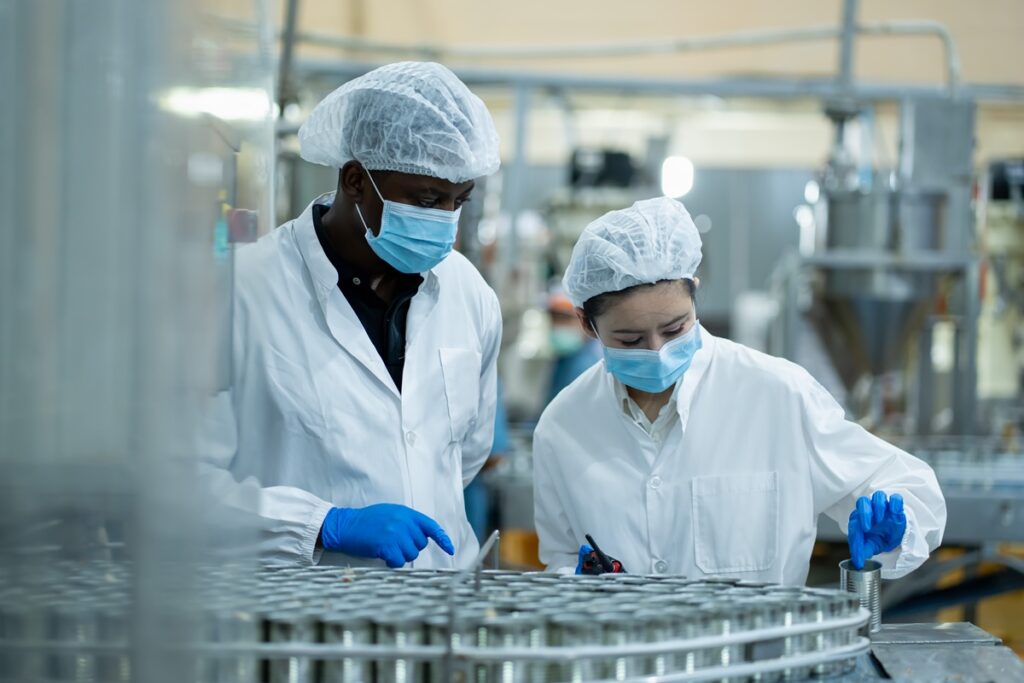

Allergen control becomes a factory-wide discipline
Allergen management is one of the clearest examples of why hygiene can no longer be viewed narrowly. The risk is not only whether a surface has been cleaned. It is whether ingredients, people, tools, labels, rework, packaging and production schedules are controlled as one system.
As product ranges become more varied and manufacturers respond to demand for plant-based, free-from, high-protein and reformulated products, allergen complexity increases. Shared lines, short runs and faster changeovers all add pressure.
Stronger allergen control starts with site design and production planning. Dedicated storage, clear colour coding, controlled movement of ingredients, validated changeover procedures, label verification and staff training all contribute to risk reduction. Digital systems can help by linking recipes, packaging artwork, production orders and line clearance checks, reducing the chance of mismatch between product and label.
For manufacturers, the commercial risk is significant. Allergen incidents can lead to recalls, brand damage, retailer scrutiny and loss of consumer trust. Treating allergen control as a whole-site discipline, rather than a technical department checklist, is now essential.
Foreign-body prevention and smarter inspection
Foreign-body control remains a critical part of health, safety and hygiene, but inspection technology is advancing quickly. Metal detection and X-ray systems remain important, yet newer tools such as machine vision, AI-assisted inspection and hyperspectral imaging are giving manufacturers more ways to identify contaminants, defects and process deviations.
Hyperspectral imaging is particularly valuable because it can analyse differences that may not be visible to the human eye or conventional cameras. This can help identify some materials that blend visually into the product stream, depending on the application. AI can also support pattern recognition, helping systems distinguish between normal process variation and genuine risk.
However, technology should not be treated as a simple replacement for prevention. Strong foreign-body control still depends on supplier approval, equipment condition, maintenance discipline, glass and brittle plastic control, staff training and good factory design. Inspection systems are most powerful when they sit within a wider prevention strategy.
Traceability becomes evidence, not administration
Traceability is increasingly central to food safety. Regulators, retailers and certification schemes expect manufacturers to prove control quickly, accurately and consistently. This is pushing businesses away from fragmented paper systems and towards connected digital records.
The value of digital traceability is not simply faster recall management. It can connect supplier approval, ingredient intake, production records, allergen controls, line checks, packaging verification, quality release and distribution data. When information is joined up, manufacturers can investigate issues faster and make better decisions.
Traceability also supports food fraud prevention. VACCP and TACCP programmes are becoming more important as businesses manage risks linked to adulteration, substitution, false claims, document manipulation and supply disruption. In a more volatile supply chain environment, it is not enough to know who supplied an ingredient. Manufacturers need stronger confidence in authenticity, documentation and chain of custody.
This makes data integrity a food safety issue. If records are incomplete, inconsistent or easy to alter, the business has a vulnerability. Good traceability systems must therefore combine technology with governance, staff training and clear accountability.
Packaging and contact materials enter the safety conversation
Packaging is no longer only a marketing, cost or sustainability decision. It is also a hygiene and safety decision.
Food contact materials must protect the product without introducing chemical, physical or microbiological risk. As manufacturers move towards recyclable, recycled, lightweight or alternative materials, technical teams must ensure that packaging still performs under real production and storage conditions.
This is particularly relevant as EU rules tighten around substances such as BPA and PFAS in food contact applications. For manufacturers selling into the EU, sourcing from EU suppliers or working with multinational retailers, these developments affect specifications, declarations of compliance, migration testing and supplier due diligence.
The sustainability agenda therefore needs to be managed carefully. A pack that supports environmental goals must also remain safe, compliant and suitable for the product, process and shelf life. Procurement, packaging development, technical and operations teams all need to be involved.
Regulation is becoming more connected
The regulatory environment is also shifting. The UK–EU SPS agreement is intended to make agri-food trade between the UK and EU easier and more predictable, but it also reinforces the need for businesses to monitor alignment with EU food safety and sanitary rules. For manufacturers, this may affect future expectations around traceability, labelling, food contact materials, official controls and supply chain evidence.
At the same time, the Food Standards Agency’s Future of Food Regulation programme points towards a more data-informed approach for large food businesses in England. The direction is clear: regulators want effective oversight, but they also want better use of assurance data, risk-based controls and evidence that reflects how modern food businesses operate.
This does not remove the need for internal discipline. If anything, it increases it. Businesses that can demonstrate strong governance, accurate records and a mature safety culture will be better placed than those relying on disconnected systems and retrospective paperwork.
Food safety culture is the real control point
Technology, equipment and regulation all matter, but culture remains the foundation. A business can have the right policies and still fail if staff feel rushed, poorly trained or unable to raise concerns.
Food safety culture is about how people behave when no one is watching. It is shaped by leadership, communication, workload, training, supervision and whether production pressure is allowed to override safe practice. The same applies to occupational safety. Slips, trips, manual handling injuries, workplace transport incidents and machinery risks are often linked to everyday decisions made under time pressure.
Manufacturers should therefore treat training as more than induction. Continuous, role-specific education helps staff understand why controls matter, not just what procedure to follow. Near-miss reporting, open communication and visible management commitment are all essential.
A strong culture also supports recruitment and retention. In a sector where skilled labour remains difficult to secure, safe, well-organised factories are better places to work.
From compliance cost to operational resilience
Health, safety and hygiene should not be seen as a cost centre. Managed well, they reduce waste, protect people, prevent recalls, improve uptime and support customer confidence.
The most resilient manufacturers are those that connect technical control with engineering, production, procurement, packaging and workforce management. They do not treat hygiene as something that happens after production, or safety as something separate from efficiency. They design factories, processes and systems around prevention.
The future of health, safety and hygiene in food manufacturing will be shaped by this integration. Safer factories will be those where risk is understood across the whole site, evidence is available when needed and every operational decision considers its impact on people, product and compliance.
For manufacturers, the message is straightforward: safety is no longer just a standard to meet. It is a system to design, manage and continuously improve.
What is changing in food manufacturing health and safety?
Food manufacturing health and safety is becoming more integrated with food safety, hygiene, engineering and digital traceability. Manufacturers are increasingly managing people, product, plant and compliance risks through joined-up systems rather than separate departmental processes.
Why is hygienic design important in food factories?
Hygienic design reduces contamination risk by making equipment and production areas easier to inspect, access and manage. Good design also improves worker safety by reducing awkward maintenance tasks, poor access and unnecessary manual handling.
How does allergen control affect factory operations?
Allergen control affects storage, production scheduling, staff movement, line clearance, labelling, rework and packaging verification. It must be managed across the whole site because allergen incidents often result from system failures rather than one isolated mistake.
What role does packaging play in food safety?
Packaging plays a direct role in food safety because food contact materials must protect the product without introducing chemical, physical or microbiological risk. New packaging materials must be assessed for compliance, migration, durability and suitability for the process.
Why is digital traceability important for food safety?
Digital traceability helps manufacturers prove where ingredients came from, how products were made and where finished goods were distributed. It supports faster recalls, stronger audits, better supplier control and improved food fraud prevention.