


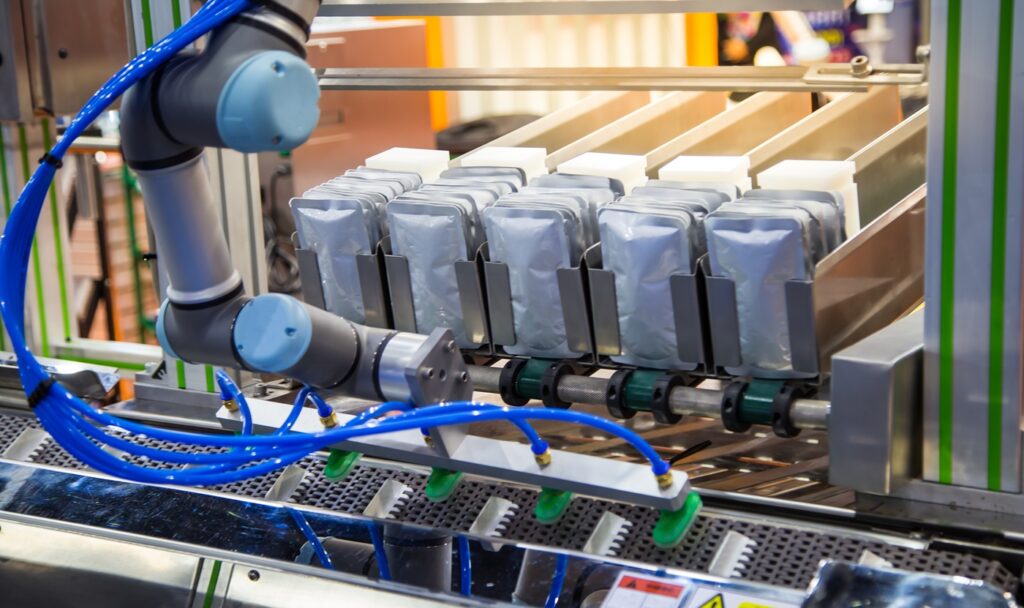
Industry Insight: Pouch packaging is no longer just a lightweight alternative to rigid formats. For food and drink manufacturers, it is becoming a material-engineering and compliance challenge. The move towards recyclable mono-material films, lower EPR exposure, PFAS restrictions, smarter sorting and higher recycled content means packaging decisions now sit directly alongside operational cost, export readiness, line efficiency and product protection.
Pouch packaging has become one of the food and beverage sector’s most versatile formats, offering lightweight logistics, strong shelf appeal and efficient portion control. But its next phase will be defined less by convenience and more by compliance, recyclability, filling-line performance and data-backed sustainability claims.
Why the pouch is changing
Flexible pouches have earned their place in food and beverage packaging because they do several jobs well. They reduce transport weight, support high-impact branding, improve cube efficiency and can be tailored for everything from snacks and confectionery to sauces, pet food, infant nutrition, dry ingredients and ready-to-eat products.
However, the same structures that made pouches so effective have also made them difficult to recycle. Traditional high-barrier formats often combine layers of PET, aluminium, nylon, PE or PP to deliver shelf life, seal strength, puncture resistance and print quality. These mixed-material laminates can be excellent from a product protection point of view, but they are increasingly exposed to regulatory, cost and brand-pressure challenges.
The market is now moving towards simpler material structures, clearer recyclability claims and stronger evidence behind sustainability messaging. For manufacturers, that means pouch selection can no longer be treated as a procurement decision alone. It affects filling-line settings, seal validation, shelf-life modelling, export compliance, waste fees and the credibility of environmental claims.

Regulation turns design into a cost issue
The EU Packaging and Packaging Waste Regulation is now a major reference point for any UK business exporting to the EU or supplying Northern Ireland. Its general application begins on 12 August 2026, with requirements covering packaging design, substances of concern, recyclability, labelling, recycled content and producer responsibilities.
One of the most immediate issues for food-contact packaging is PFAS. Under the PPWR, food-contact packaging placed on the EU market must meet specific PFAS concentration limits from 12 August 2026. For pouch manufacturers and food brands, this places renewed focus on coatings, inks, adhesives and high-barrier treatments, not just the visible film structure.
In the UK, Extended Producer Responsibility is also changing the economics of packaging. The Recycling Assessment Methodology rates packaging using a red, amber or green scale, affecting the disposal fee charged. For year two illustrative EPR fees, less recyclable red-rated packaging is shown as attracting a 20 per cent uplift compared with the amber fee, while green-rated packaging may receive a discount.
This matters because pouches have often sat in the awkward middle ground: efficient to transport and attractive on shelf, but hard to process at end of life. As EPR fees become more closely linked to recyclability, a pouch that performs well technically but scores poorly in recyclability assessments could carry a direct margin penalty.
The mono-material challenge
The most obvious response is to move from complex laminates to mono-material PE or PP structures. In principle, this makes sense. A pouch based mainly on one polymer is easier to identify, sort and recycle than a multi-layer structure combining incompatible materials.
In practice, the switch is rarely simple. Food products impose different barrier needs. A dry snack does not require the same oxygen, moisture, grease or aroma protection as a retorted sauce, wet pet food or high-fat confectionery. The more demanding the product, the more difficult it becomes to remove aluminium foil or mixed barrier layers without affecting shelf life.
This is driving interest in advanced coatings and vapour-deposited barriers such as SiOx and AlOx, which can improve oxygen and moisture resistance while maintaining a more recycling-friendly structure. High-barrier paper and fibre-based pouch materials are also gaining attention, especially where they can move packaging into a paper recycling stream rather than depending on still-developing flexible plastic infrastructure.
The key point for manufacturers is that there is no universal “sustainable pouch”. Every switch needs to be tested against product chemistry, filling temperature, distribution conditions, shelf-life targets, pack handling, print requirements and end-of-life compatibility.

Sealing becomes a production risk
A recyclable pouch that cannot run efficiently on existing equipment will not deliver a commercial benefit. This is where material change becomes a plant-floor issue.
Traditional laminates often combine a higher-melting outer layer with a lower-melting sealing layer. That gives production teams a workable thermal window. Mono-material structures can narrow that window significantly. If too much heat is applied, the pack can distort, wrinkle or burn through. If too little heat is applied, seal integrity can suffer.
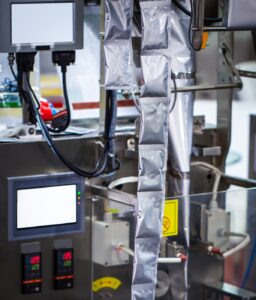
For high-speed filling and sealing lines, this means closer control of jaw temperature, dwell time, pressure, cooling and film tension. Infrared sensors, closed-loop control, machine vision and AI-driven process adjustment are becoming more relevant because sustainable films can be less forgiving than legacy laminates.
Ultrasonic sealing is also attracting interest because it uses high-frequency vibration to generate heat within the sealing area rather than relying only on external hot jaws. For some applications, this can support stronger seals, lower energy use and improved performance where contamination, product residue or narrow heat windows create problems.
The operational lesson is straightforward: pouch redesign should involve packaging suppliers, machinery engineers, quality teams and production managers from the start. A material that looks good in a sustainability review still has to survive commissioning, validation, cleaning, changeovers and real factory variation.
Smart packaging and sorting infrastructure
The next stage of pouch development is not only about materials. It is also about information.
Digital printing, QR codes, 2D barcodes and product-level data can support traceability, consumer engagement, recycling instructions and future digital product passport requirements. For food and beverage brands, this creates an opportunity to connect packaging with batch information, sustainability data, allergen communication, product authentication and supply chain visibility.
At the recycling end, digital watermarking remains one of the most important developments to watch. Invisible codes embedded into packaging artwork can be detected by high-resolution cameras at sorting facilities, helping waste operators separate packaging by material, application or food-contact status. If widely adopted, this could improve the quality of recycled feedstock and make flexible packaging more attractive within circular systems.
The challenge is scale. Smart sorting only works when enough packaging carries the right markers and enough infrastructure can read them. For now, manufacturers should view digital watermarks and connected packaging as part of medium-term packaging strategy, rather than an immediate replacement for good design-for-recycling principles.
Recycled content moves closer to flexible films
Recycled content has been easier to incorporate in some rigid packaging formats than in food-contact flexible films. Flexible packaging requires tight control over odour, contamination, mechanical performance, printability and sealing behaviour.
Recent trials in recycled polypropylene films show that progress is being made. BOPP films with more than 40 per cent post-consumer recycled polypropylene content have been produced and evaluated, with suppliers reporting comparable processing, barrier and sealing performance to virgin PP films.
For food manufacturers, this is significant because recycled-content mandates and plastic tax exposure are pushing the market beyond lightweighting alone. The goal is no longer simply to use less plastic. It is to use materials that are recyclable, contain credible recycled content where permitted, and maintain food safety and line performance.
Advanced recycling also remains part of the conversation, particularly for flexible plastics that are difficult to recycle mechanically. Projects involving post-consumer flexible packaging and chemical or advanced recycling technologies are being tested in the UK, but food manufacturers should still treat these systems as developing infrastructure rather than a guaranteed end-of-life route.
From sustainability claims to proof
One of the strongest shifts in packaging is the move from broad environmental language to substantiated sustainability. Claims such as “recyclable”, “recycle-ready”, “reduced plastic” or “lower carbon” now need more evidence behind them.
That evidence may include material specifications, recyclability assessments, supplier declarations, chain-of-custody documentation, recycled-content certification, life-cycle data and proof that the pack can run at commercial speed without increasing waste. For businesses selling across multiple markets, documentation will be as important as the pack itself.
This is especially relevant for pouches because the format can create trade-offs. A lighter pouch may reduce transport emissions but be harder to recycle. A paper-based pouch may improve recyclability perception but require coatings that affect repulpability. A mono-material film may improve end-of-life potential but reduce shelf life if the barrier is not right.
The strongest packaging strategies will be those that measure the full operational picture, not just the headline sustainability claim.
What manufacturers should do now
Food and beverage manufacturers reviewing pouch packaging should begin with a practical audit. Which SKUs use multi-material laminates? Which are exported to the EU or sold into Northern Ireland? Which products need high oxygen, moisture, aroma or grease barriers? Which packs are most exposed to EPR fees, retailer pressure or consumer scrutiny?
From there, the focus should move to controlled trials. Manufacturers should test mono-material PE and PP structures, fibre-based alternatives and advanced barrier coatings against real product, real machinery and real distribution conditions. Shelf life, seal integrity, pack appearance, filling speed, downtime, leakers, waste rates and changeover performance all need to be measured.
Collaboration will be essential. Packaging suppliers can advise on film structures, recyclability and compliance. Machinery partners can support sealing trials and control upgrades. Compliance teams can assess UK and EU obligations. Commercial teams can decide whether sustainability improvements justify higher material costs or support stronger retailer relationships.
Pouch packaging is not disappearing. In many cases, it remains one of the most efficient formats available. But the easy era of flexible packaging is over. The next generation of pouches must prove that they can protect food, run efficiently, support credible recycling pathways and stand up to a tougher regulatory environment.
For manufacturers, the opportunity is to treat pouch redesign not as a defensive compliance exercise, but as a way to reduce risk, protect margin and build packaging systems that are ready for the next decade.
Why are food and beverage manufacturers redesigning pouch packaging?
Manufacturers are redesigning pouch packaging because traditional multi-layer flexible materials are increasingly exposed to recycling, EPR and compliance pressures. The focus is shifting towards recyclable mono-material structures, stronger sustainability evidence, lower waste fees and packaging that can still protect product quality and run efficiently on high-speed lines.
Are mono-material pouches always better?
Not always. Mono-material PE or PP pouches can improve recyclability, but they may not deliver the same barrier performance as complex laminates for every product. Wet foods, retorted products, high-fat foods and sensitive ingredients may need advanced coatings or alternative structures to maintain shelf life and safety.
What is the main production challenge with recyclable pouches?
The main challenge is often sealing. Mono-material films can have a narrower thermal window than traditional laminates, making them more sensitive to heat, dwell time and pressure. This can require line recalibration, better process control, improved cooling or investment in technologies such as ultrasonic sealing.
How does EPR affect pouch packaging?
Extended Producer Responsibility links packaging costs more closely to recyclability. Packaging that is harder to recycle can attract higher fees, while better-rated formats may reduce exposure. This makes recyclability a direct commercial issue, not just a sustainability objective.
What role will smart packaging play in pouch design?
Smart packaging can support traceability, recycling guidance, product authentication and future digital product passport requirements. QR codes, 2D barcodes and digital watermarks may help connect packaging to compliance data and improve sorting, but they work best alongside good material design.