


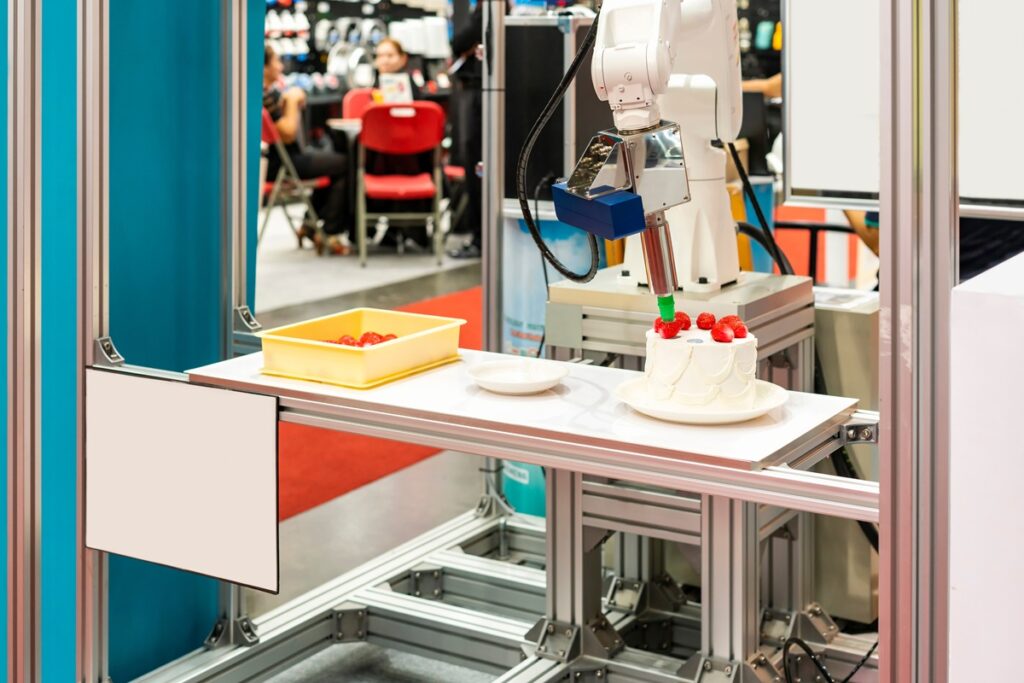
Industry Insight: Global investment in industrial robotics continues to grow, but the UK risks falling further behind its manufacturing competitors. The International Federation of Robotics valued annual industrial robot installations worldwide at a record US$16.7 billion, while identifying AI-powered robotics, humanoid development, labour shortages and greater convergence between automation and information technology among the defining trends shaping the market.
AI copilots, adaptive robotics, hyperspectral inspection, intelligent cleaning and connected data are changing what production machinery can see, predict and improve—while raising new questions around governance, cybersecurity and return on investment.
UK industrial robot installations fell by 35% to 2,500 units in 2024, placing the country 19th globally. The food and beverage sector accounted for only 4% of worldwide industrial robot installations, suggesting considerable remaining scope for automation in processing, packing, inspection and end-of-line operations.
The next competitive divide will not simply be between automated and manual factories. It will be between manufacturers whose equipment can generate useful operational intelligence and those still relying on isolated machines, fragmented data and reactive intervention.
Machinery has always determined how quickly, safely and consistently food can be produced. What is changing is the type of value manufacturers expect it to create.
A modern processing or packaging system is increasingly expected to monitor its own condition, recognise product variation, verify quality, record compliance information and adapt its operation without waiting for a supervisor to adjust every setting.
This does not mean production lines are becoming autonomous in the science-fiction sense. It means equipment is becoming more capable of making tightly controlled decisions within clearly defined operating limits.
For manufacturers facing labour shortages, fluctuating energy costs, shorter production runs and demanding retailer specifications, that intelligence can be as valuable as mechanical speed.
The machinery investment case is consequently changing. Throughput remains important, but the strongest equipment can also reduce giveaway, prevent unplanned downtime, shorten changeovers, improve cleaning efficiency and produce a defensible digital record of what happened to every batch.
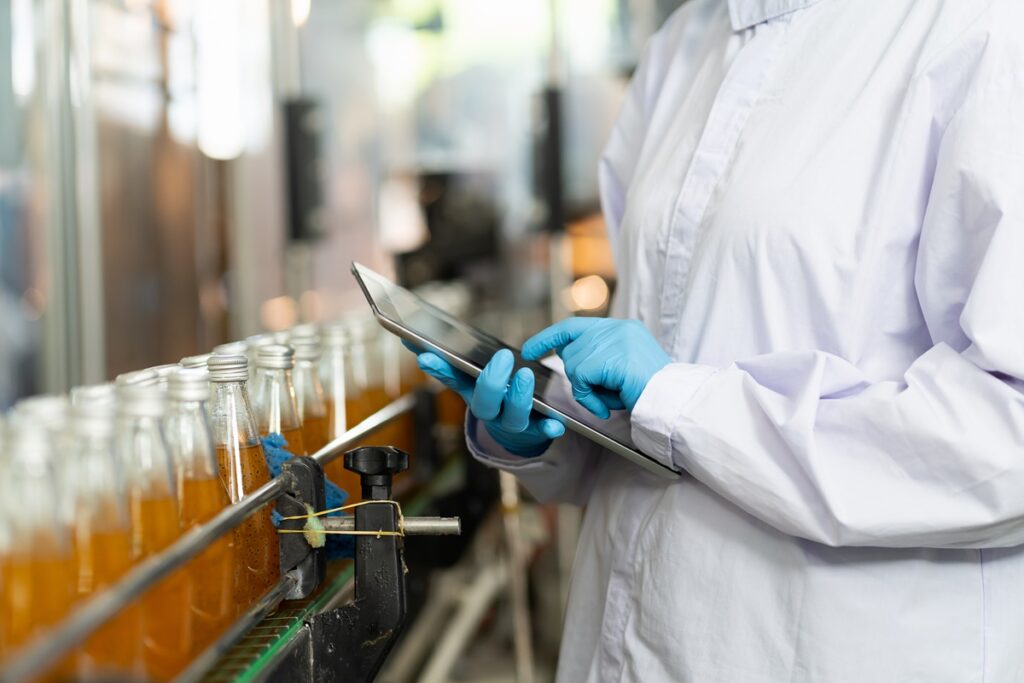
Ask the Machine: Edge AI Brings Expertise to the Line
Predictive maintenance is no longer a new idea. Sensors monitoring vibration, temperature, current, pressure and acoustic behaviour have been used for years to detect developing problems.
The next step is making that information easier to interpret and act upon.
AI copilots are beginning to provide a conversational interface between technicians and complex machinery data. Instead of searching through manuals, alarm histories and maintenance records separately, an engineer could ask why a motor is drawing more current, which previous failure showed similar symptoms or what checks should be completed before restarting a line.
The underlying technology may combine sensor readings, operating procedures, service histories and equipment documentation. Running appropriate functions on local edge hardware can also reduce latency and limit the amount of sensitive production data leaving the site.
The value is not the conversation itself. It is the ability to shorten the distance between an abnormal signal and an informed maintenance decision.
However, generative AI should not be treated as an infallible engineer. A convincing answer can still be wrong, particularly when equipment records are incomplete or documentation is outdated. Safety-critical instructions must remain controlled, validated and subject to competent human approval.
The most useful systems will provide evidence alongside recommendations: the sensor trend, relevant manual section, previous work order and level of confidence behind the diagnosis.
Used properly, the copilot becomes a route into existing engineering knowledge rather than an unaccountable replacement for it.
See Beneath the Surface: Inspection Moves Beyond the Camera
Conventional machine vision has transformed packaging and product inspection. High-speed cameras can confirm label position, date-code presence, cap alignment, fill level and obvious surface defects without slowing the line.
Yet a standard colour image can only detect what is visually apparent.
Hyperspectral and multispectral systems combine spatial imaging with information from different wavelengths of light. When integrated with machine learning, they can distinguish materials and quality characteristics that appear identical to the human eye.
Research is expanding their use in detecting foreign material, bruising, moisture differences, contamination indicators, maturity and internal quality variations across fruit, vegetables, grain, meat and other food categories.
This creates possibilities that extend beyond sorting by colour or size. An inline system could identify produce beginning to deteriorate beneath the surface, separate raw materials according to compositional characteristics or detect an unexpected substance within a visually complex product stream.
Deep-learning models can also combine several sources of information. A quality decision might draw on hyperspectral data, conventional imaging, weight, temperature and acoustic measurements rather than relying on one sensor.
For manufacturers, the obstacle is no longer whether such systems can work in laboratory conditions. It is whether they can maintain accuracy at commercial line speeds, under changing lighting, temperature, dust and product conditions.
Models trained on one variety, supplier or season may perform differently when raw materials change. Calibration, reference samples and ongoing validation therefore become part of routine quality management.
The return must also be attached to a defined loss. Advanced imaging is easier to justify when it reduces customer complaints, prevents contamination, improves grading yield or recovers saleable product that would otherwise be rejected.
Robots Learn the Product: Physical AI Expands Flexible Automation
Traditional robots perform exceptionally well when products, positions and movements remain consistent. Food manufacturing frequently provides the opposite conditions.
Products bend, slide, vary in shape and arrive in unpredictable orientations. Packs change size, seasonal lines appear for short periods and delicate items cannot be handled with the same force as rigid components.
Advances in vision, gripper design and machine learning are helping robots respond to this variability. Rather than executing only a fixed programmed movement, an AI-enabled system can identify an object, estimate its position, select an appropriate gripping point and adjust its movement according to the product it encounters.
The International Federation of Robotics describes this progression as physical AI: robots learning in simulated environments and applying that experience to real-world operation rather than depending entirely on conventional programming.
The near-term opportunities are practical rather than theatrical. They include mixed-product picking, random depalletising, flexible case packing, variable portion handling and robotic cells that can accommodate more than one product format.
Humanoid robots have attracted attention because human-shaped machines could theoretically operate in factories designed around people. In most food plants, however, purpose-built equipment remains faster, easier to clean and simpler to validate.
The greater opportunity lies in borrowing the perception and adaptability associated with physical AI without assuming that the machine must resemble a person.
Digital simulation is becoming important here. Robot cells can be tested virtually against different products, speeds, grippers and layouts before equipment is purchased or installed. This “simulate first” approach can expose collisions, unreachable positions and unrealistic cycle-time assumptions while changes remain inexpensive.
It also forces manufacturers and suppliers to confront the simulation gap: the difference between a controlled digital model and a real factory containing damaged cartons, wet surfaces, changing ingredients and human intervention.
Clean Until It Is Clean: Sensors Challenge Fixed CIP Recipes
Cleaning-in-place systems have traditionally relied on validated combinations of time, temperature, chemical concentration and flow.
These recipes provide repeatability and food-safety assurance, but they can also create over-cleaning. A cycle designed for the most difficult expected soil may continue long after a more lightly contaminated circuit has reached the required condition.
The development of inline optical, conductivity, acoustic and spectroscopic sensing creates the possibility of more responsive cleaning. Instead of using time as the primary measure, equipment can monitor what is returning from the circuit and identify when product residue or cleaning chemical has reached an acceptable level.
Recent research has explored real-time and inline monitoring approaches capable of detecting food residues and cleaning-agent components during CIP. The wider aim is to improve cleaning verification while reducing unnecessary consumption of water, energy and chemicals.
This does not mean abandoning validated cleaning programmes or allowing an algorithm to shorten cycles without control. Food safety must remain the first requirement.
The opportunity is to build stronger evidence into the process. A sensor-supported system can show whether conditions were achieved, identify gradual performance changes and reveal when valves, spray devices or flow paths are no longer behaving as expected.
Cleaning data can also become predictive. If one circuit repeatedly takes longer to reach its validated endpoint, the cause may be increasing fouling, poor drainage, a worn component or an unsuitable production sequence.
In that sense, intelligent CIP is not simply a sustainability technology. It can become an early-warning system for equipment and process performance.
Twin Before Steel: Virtual Models De-risk Real Investment
Digital twins remain valuable, but their role is becoming more commercially disciplined.
The early vision often focused on immersive factory models and virtual-reality environments. The more immediate return comes from testing specific decisions before making expensive physical changes.
A digital representation of a line can assess how a faster filler will affect downstream accumulation, whether a new product will destabilise a thermal process or how additional inspection time will influence overall throughput.
It can also model utilities. Steam, compressed air, refrigeration, water and electricity demand can be examined alongside production output, allowing engineering teams to see whether an apparent speed improvement creates a costly peak elsewhere.
For equipment procurement, the twin can compare proposed machinery against realistic demand rather than headline maximum speed. Changeovers, cleaning, maintenance, product mix, stoppages and operator interventions should all be included.
A machine capable of 300 packs per minute provides little advantage if upstream supply is inconsistent or downstream equipment repeatedly stops at 220.
The same model can support commissioning and training. Operators can learn sequences, practise fault recovery and understand the effect of parameter changes without placing live production at risk.
The limiting factor remains data quality. A digital twin built on optimistic assumptions produces a sophisticated version of the wrong answer. Manufacturers need representative cycle times, failure patterns, product variation and utility data if the model is to guide capital decisions.
The Machine Must Explain Itself: Regulation Reaches Connected Equipment
As machinery becomes more intelligent and connected, equipment procurement is being drawn into a new regulatory environment.
The EU AI Act is introducing risk-based obligations for artificial intelligence. Transparency requirements begin applying from 2 August 2026, while the revised timetable places rules for high-risk AI embedded in regulated physical products, including machinery, from 2 August 2028.
Not every inspection algorithm, maintenance model or production optimiser will be classified as high risk. Nevertheless, manufacturers should already be asking how an AI function was trained, what operating limits apply, how performance is monitored and what human override is available.
The EU Data Act has applied since 12 September 2025 and strengthens users’ rights concerning data generated by connected products. For machinery buyers, that makes access to operational data, export formats and third-party service rights an important contractual issue rather than an afterthought.
A manufacturer may technically own a machine while remaining unable to access its raw condition data without paying the supplier or remaining within a proprietary cloud platform. That restriction can limit predictive maintenance, integration and the freedom to change service providers.
Cybersecurity is moving in the same direction. Reporting obligations under the EU Cyber Resilience Act begin on 11 September 2026, with its main product requirements applying from December 2027. Connected-equipment suppliers will face greater expectations around secure development, vulnerability handling and software support.
Food producers do not need to become technology lawyers, but they do need clearer answers from suppliers. How is remote access controlled? How long will security updates continue? Can unsupported software prevent the machine operating? What happens when a vulnerability is discovered?
For packaging equipment, the EU Packaging and Packaging Waste Regulation also applies from 12 August 2026. The machinery implication is practical: lines may need to accommodate changing materials, lightweight formats, reuse systems and more detailed packaging information without sacrificing seal quality or output.
Traceability remains another driver. The FDA will not enforce its Food Traceability Rule before 20 July 2028, but the required Critical Tracking Events and Key Data Elements remain relevant to companies supplying covered foods into the US market.
The delay should be treated as implementation time, not permission to continue with fragmented records. Equipment that automatically links batch, process, inspection and packaging data can remove a significant burden from future compliance.
Measure the Constraint: ROI Moves Beyond Labour Savings
The weakest machinery projects begin with a technology and search for somewhere to install it. The strongest begin with a measurable operational constraint.
That may be unplanned downtime, poor inspection consistency, excessive giveaway, slow changeovers, high cleaning consumption, repetitive manual handling or insufficient traceability.
Once the constraint is clear, the investment can be judged against the correct measures.
A predictive-maintenance system should be evaluated through avoided downtime, maintenance planning and asset life. An inspection system should be measured through false rejection, complaint reduction and recovered yield. Intelligent cleaning should be assessed through verified hygiene performance alongside water, chemical, energy and lost-production time.
Manufacturers should also account for the cost of complexity. Advanced equipment may require new data infrastructure, specialist training, model validation and stronger cybersecurity. A system that performs brilliantly but cannot be supported by the site team can create dependence rather than resilience.
Retrofit may offer the best starting point. Existing machinery can often gain useful condition monitoring, energy metering, vision inspection or data connectivity without replacing the entire asset.
In other cases, retrofitting creates an expensive collection of interfaces around a machine that was never designed to share data. The decision should reflect remaining asset life, criticality, hygiene design and the cost of integration.
Supplier capability is equally important. The equipment provider should be able to explain not only maximum output but how the system responds to product variation, lost connectivity, sensor failure and manual recovery.
Acceptance testing must represent the real operation: different products, imperfect materials, cleaning conditions, shift changes and foreseeable faults.
Intelligence With a Purpose: The New Machinery Standard
The next generation of production equipment will not be defined by how much AI it contains. It will be defined by whether that intelligence solves a genuine manufacturing problem.
A useful machine sees variation that matters, predicts failures early enough to act, verifies its own performance and gives people the information needed to make better decisions.
It should also remain cleanable, maintainable, secure and understandable.
For senior decision-makers, this changes the machinery conversation. Capital expenditure is no longer only a choice between speed, footprint and purchase price. It is a decision about data access, operational resilience, workforce capability and the flexibility to meet future product and regulatory demands.
Machines are becoming part of the factory’s decision-making infrastructure. The manufacturers that benefit most will not be those that automate everything, but those that apply intelligence precisely where uncertainty, waste and risk are costing them most.
What is intelligent machinery in food and beverage production?
Intelligent machinery combines mechanical equipment with sensors, software, connectivity and analytical tools. It can monitor operating conditions, identify abnormalities, adapt controlled settings, verify product quality and provide data to maintenance, manufacturing execution and traceability systems.
How can AI reduce machinery downtime?
AI models can analyse vibration, temperature, electrical current, pressure and maintenance history to identify patterns associated with deterioration. This allows maintenance teams to investigate developing problems before they cause an unexpected stoppage. The quality of the result depends on reliable sensor data, appropriate training and human validation.
What is hyperspectral imaging used for in food production?
Hyperspectral imaging captures information across many wavelengths rather than producing only a conventional colour image. It can help detect compositional differences, foreign materials, bruising, moisture variation, maturity and some defects that may not be visible on the surface.
Are AI-powered machines covered by the EU AI Act?
Some are. The Act uses a risk-based approach, meaning requirements depend on the function and potential impact of the AI system. High-risk AI embedded in regulated products such as machinery faces stronger requirements, while many routine optimisation and inspection applications may fall into lower-risk categories.
How should manufacturers calculate machinery ROI?
ROI should be linked to the operational constraint being addressed. Measures may include output, avoided downtime, labour requirements, product giveaway, energy use, water and chemical consumption, customer complaints, stock loss, changeover time and maintenance cost. Integration, training and ongoing software support should also be included.