


A single promotion was discovered on eggs – a packaged snacking option rather than a carton of eggs meant for everyday use. This finding coincides with The Food Foundation’s latest release of national food insecurity data, which reveals that 17% of households are struggling to afford food.
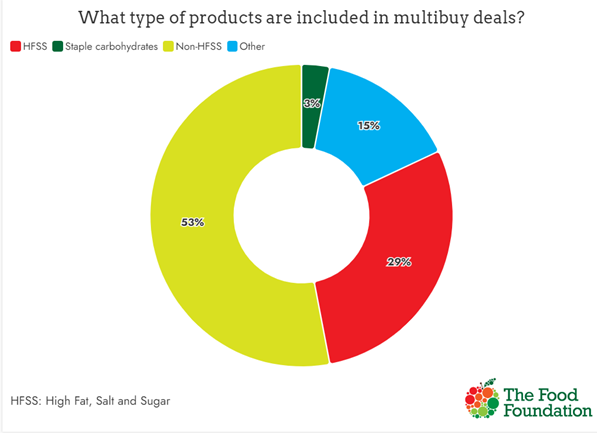
The government recently postponed restrictions on multibuys or ‘buy one get one free’ (BOGOF) deals for high-salt, high-sugar, and high-fat (HFSS) foods. Their argument was that families would require access to these price reductions during the cost of living crisis. However, this new data indicates that essential foods needed during the crisis are not subject to multibuys. Instead, almost a third (29%) of multibuys feature HFSS products.
Funded by Fusion21, The Food Foundation’s Kids Food Guarantee reveals that only a negligible percentage of deals pertain to staple ingredients or essential items for feeding families.
The disproportionately higher price of healthier calories, compared to less healthy options, poses challenges for individuals struggling with the cost of living to afford a nutritious diet. This is especially true for low-income groups. Unfortunately, the current distribution of multibuys does not alleviate the affordability issue concerning basic staple foods such as fruit and vegetables.

Similar to advertising spend in the UK, where only 1% goes toward fruit and vegetables compared to a third (33%) spent on confectionery, snacks, desserts, and soft drinks.
In the non-HFSS multibuy category, a wide range of foods are available, including marinades, sauces, spices and herbs, kitchen ingredients, and composite foods such as ready meals.
The category ‘Other’ includes products where nutrient information is missing online, making it challenging to calculate an accurate NPM score and determine whether the product is HFSS or not.
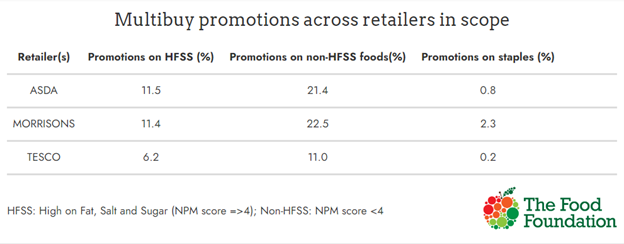

The Food Foundation data emphasizes that promotions could be a useful tool for helping consumers stretch their food budget further, provided the promotions focus on essential items. However, unless such promotions are structured to allow citizens to afford healthier staple foods, instead of discretionary HFSS foods, multibuy offers will only hinder efforts to make healthier diets more accessible and affordable.
The Kids Food Guarantee advocates for the following changes:
- Where multibuy deals are offered, retailers and manufacturers should prioritize deals on staple carbohydrates and healthy essentials like fruit and vegetables, milk, and eggs, rather than less healthy HFSS foods.
- Other retailers should follow the responsible business leadership of Sainsbury’s and commit to banning promotions on HFSS foods, despite the government’s decision to delay the planned implementation of this policy until October 2025. Retailers that have made commitments to phase out HFSS promotions, such as Tesco, should swiftly implement those commitments.
- The government should reconsider the delay of the planned ban on HFSS promotions. Without urgent action to rebalance the food environment, the government cannot achieve its goal of halving childhood obesity by 2030.
According to Anna Taylor, executive director of The Food Foundation, “Levels of food insecurity remain worryingly high, with 17% of households experiencing food insecurity in June 2023. This is over twice as high as levels in January 2022.
“With food price inflation falling only very slowly, we need both government and retailers to urgently step up and support households through the cost-of-living crisis.
“That support needs to ensure that families can access and afford healthy staples such as fruit and veg. Running promotional deals on junk food simply makes it even harder for many to access and afford nutritious food.”
Katharine Jenner, director of the Obesity Health Alliance, said, “It’s approaching three years since then Prime Minister Boris Johnson pledged to take bold steps to prevent obesity, which leads to poor health outcomes such as cancers, heart disease, and type 2 diabetes.
“Yet, the government’s delays in restricting multibuy offers neither save people money nor promote a shopping basket full of healthy food.
“Supermarkets should offer special deals on healthier foods that are on people’s shopping lists and do not harm their health, contributing to a healthier Britain.”